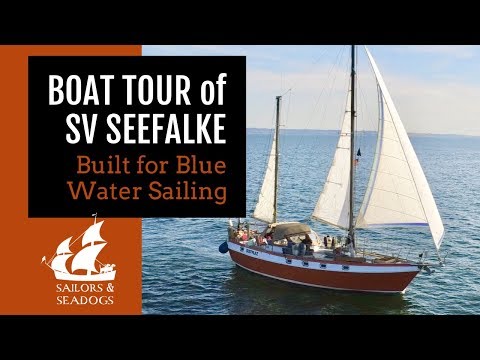
Here we are on Sailing Vessel Seefalke.We will take you on a tour today of our
floating home and floating office. This is a really long video and we get that
We hope that you'll watch all of it but if you don't want to watch all of it
we did break it down into sections. In the description below you'll see the
timestamps of each section so you can fast forward through to the sections
that interest you and skip the sections that don't interest you.
Welcome On Board!
Seefalke was built specifically for the kind of blue water sailing that
we've been doing since we left Stralsund, Germany on August 19th 2018. She has
safely taken us across the Baltic Sea, through the Kiel Canal, the North Sea, the
English Channel, the Bay of Biscay, and all along the Spanish and Portugal
Atlantic coastlines... into Morocco and down the northwestern African coast to
the Canary Islands and now into Cape Verde
Next, we cross the Atlantic Ocean with Barbados in our sights. Eventually we
will bring Seefalke to Sweet Home Alabama to visit friends and family
before we head out on our next adventure
Seefalke is a Seahawk 37 designed and built in the Netherlands by Jachtbouw Noord
in 1974. Seefalke is a long keel, ketch-rigged,
steel ship with 37 feet waterline and 43 feet length overall. Seefalke weighs about
10 tons and she's not a racer but she's safe and seaworthy as can be.
Our ship, Seefalke, has only had three owners in her 44-year life... Norbert
Drucker, Bernd Oltmann and Maik Ulmschneider. During Norbert's childhood his father
sailed her for 35 years. He sold her too Bernd in 2009. Bernd is
the president of VBS, a sailing club in Bremen Germany. Seefalke was the crown jewel
of the club for eight years until Bernd sold her to Maik in 2017. While we were
sailing through the Kiel Canal in August 2018 we had a rare opportunity to have
all three owners together to talk about our seaworthy ship. This was the biggest sailing ship
in our club and for us you know we always had only small ones and
then Seefalke came it was unbelievable. It was good! And then we decided to sell her and you know.....and you are only the third owner.
Built in 1974 and only three owners. This means a lot. As youngsters, I can remember that
Norbert's parents, his father, he allowed us to sail her this once you know so then we
were young and in such a big sailing boat is what was really exciting!
Welcome to the upper deck of Seefalke. We are here by the bow sprit. Remember we lost
boards in our first gale but I haven't felt like replacing
them. We've had much other things on our list that were more important. I think
it's even more practical. This is the bow sprit. We have two forestays
A port forestay and the starboard forestay which is a typical rig for the old
trade wind boats that had two foresails. They would have one genoa and one fore
sail on on forestay and the Genoa on the other forestay and yeah just ride trade
winds with two genoas. On the port forestay, we have rigged a furling
Genoa and it's about 120 percent overlapping Genoa we have some trouble
with the furling mechanism forever but the thing is fixed now let's see
and we have not used the second foresail yet but I guess we're gonna
use it on the big crossing. And we have a cutter stay that's this
one here. The cutter stay is the third forestay that we have. It carries our
jib. It's a self-jibing jib. You see over
there you see that rail. When we jibe the jib slides automatically.
The jib has a boom, which is in today's design a rare design, but I love it.
It really helps, especially if you're on a broad reach or downward course
it helps to stabilize the jib. it's very good. A very good design.
This is our primary anchor. It is a 25 kilogram anchor and holds pretty well. It goes
with a 40-meter anchor chain that allows us to anchor in depths up to 15 meters.
Talk about this sea fence that you're leaning on right now because this is one
of my favorite features. Oh yeah, you can see the this boat is designed for heavy
weather sailing. It has a massive sea fans. It's welded with two
rails. It goes all the way from the bow to the stern and back on the other side. It's
really massive and in combination with our sea fence over here
it holds major blows. If some of or some equipment are getting lifted in
heavy waves it can crash against the sea fence. A lot of other sailors we have talked to talk
about our sea fence and how they wish they had one and how they have to strap in
See our neighbor's seafence. It has massive beams yeah I mean you would have to strap yourself in and
really even in just general situations out on the foredeck on that boat whereas
here this really you can hold on to it and it will hold you. It will definitely
hold the weight of large human beings and of course the seadogs . Then we have our potty area.
This is for the dogs, not the humans. And this is our hatch that goes down into the bow cabin.
This is specifically practical when we have to change sails so
then one of us will be down there, one of us will be up here to just take over the
sails through the hatch. You know we just hand it up right through the hatch it's
very convenient and so we keep all our extra sails down in the in the bow
except for the mizzen staysail which we'll talk about when we get back to the
stern and the cockpit Exactly. Let's talk about mast fence that's
another unique feature of this boat. It's the mast fence.
In today's designs,
most of the lines go into the cockpit so its made for most of the work you
have to do main mast you don't have to leave the cockpit which of course adds to
safety. In the 70s design, that was not possible so for all sailing
maneuvers or for most sailing maneuvers someone has to come here to the mast no
matter what the conditions. That makes me feel especially safe when I have to
come out and hoist or bring in the mainsail. You can lean
against it with your full body weight, you can work the winches, work the halyards, work the sails, and you have both hands available for work.
What's that hanging there? That's our warm water system. We do not have a shower inside. We just fill it
with water see it's all black dirty it's all black dirty on the outside but
it's clean the inside so fill it with water and we expose it to
the Sun. The water heats up really good and we just sit here and
have a shower deck. The mast is also a massive design. It's twelve point
something meter high so you may say that's not very high and it's not very high
but since we have two masts, we can easily distribute the sail area out over two
masts which makes it easier to handle.
Every sale of little lighter and a
little smaller. If you only have one mast and if worst case one mass breaks down
you still have the other one. It's a little backup and also one of the major
advantages of two masts is you can balance and
trim the boat just a little better. There are more options. We have we don't have a
furling system on the main sail. We have to come out on the deck and
bring the sail up and down manually. We have three reef lines though so we
can manually increase or decrease the area of of the mainsail. Then at the main
mast we have several electrical outlets and we run a spotlight over here so this
is especially helpful when we enter a port or a marina in the dark and up
there we have another spotlight this is the deck light that illuminates the deck
when we have to do maneuver in the dark. This really helps very much.
As we have passages very far away from land and very far away from gas stations and
possibilities to re-provision we also carry extra canisters of gas, diesel,
and water. All over here we use different canisters for the different liquids so
the steel canisters are diesel the plastic canisters are for gas that we use for
the outboard motor or in our generator and the white canisters and you may see more
on the on the stern stern deck it's the water, fresh water for drinking
Here's is one part of our power station, a solar power station the dogs
are guarding it, they love it because it's warm, of course the captain doesn't love them using it not for
its intended purpose. Its 200 watt solar power. It is walkable.
You can walk on it and it really helps a lot it's our main source of energy when we
are out there in the sun. We also have several mobile solar panels that have between
seven and twenty watt peak and they help us to charge our electronics
so when we are at sea we charge battery packs with them and we
charge our mobile phones or iPads and we can move them around wherever the sun shines best.
These solar panels are sometimes covered by the sails, but we can't move it.
This is our generator it's a two kilowatt portable generator that runs on gas. It's
very loud. It's very fumy, but it already saved our asses
when we were short of power on the way from the Canaries to Cape Verde when our motor broke down.
Here we are on the stern deck. It's mainly a cargo area this is like a garage an open-air garage anyway it has
a secondary and tertiary steering device so we do have another steering wheel
that runs on the on the hydraulic steering mechanism and we have a
mechanical emergency tiller
that is also great rudder indicator. Here as you can see we
have two life rafts, one here and one over there. So why do we have to live rafts?
This boat came with a life raft but life rafts need regular maintenance so we
invited some friends to sail with us at a time where the other life raft was
getting its maintenance so I bought a second life raft for this boat and yeah
I could have sold it but we decided to keep it. I also I watched the movie
"All is Lost" one too many times and I wanted to make sure we always have a
good life raft. We have three anchors on board, so the first one we saw in the bow sprit.
This is the secondary anchor that we either use as a second anchor or that we
use over the bow. We use it as a stern anchor occasionally and yeah we
have a spare anchor down in the stern cabin. Usually the dinghy is here on
the stern deck and we keep it here uninflated. We roll it up real
tight and it kind of goes in this area right here. We inflate it only when we
use it. We've had sometimes we just pull it behind that's when we do
some anchor hopping and we don't want to haul it up and down again
all the time so we just drag it behind but usually it goes here together with the outboard motor.
I love this little dinghy although there's not a lot of room on it it's
pretty small for the four of us but we manage. it's a great little tender.
This is a fun family activity. We are all in this teeny tiny dinghy and Maik is rowing us off to shore. Backward
But we're all here and we're cozy. I don't know if the pumps are too
impressed yet but they will be when we get to the beach.
This is our little outboard motor and Maik got this when he saw how much I struggled paddling the
dinghy so that was kind of a present for me. Thanks, Maik!
We do not only use the wind as a means of propulsion,
we also use the wind to produce some electrical energy so we have a super wind 350 the
350 watt wind generator that helps us charge batteries and especially helpful
when we are at sea underway or when we are at anchorage somewhere in
the Trade Winds. We can count on approximately three to four ampaires
from this wind generator. Here we are stading in front of the mizzen mast so
yes our rear mass is called a mizzen mast. It carries the mizzen sail over here
is the mizzen boom. It also carries a mizzen staysail
we call it a pusher sail that goes between the mizzen mast and the main
mast and it's like a little gennaker for the mizzen mast. You love to play with
that mizzen stay sail because there's lots of different configurations. It's not
easy to set but it gives us a little boost of half to almost one extra knot when the wind comes right.
It's also kind of pretty.
I'm going to show you around the main cabin it's actually clean today
which it's normally not. I'm sure we've got lots of footage of it the way I
normally looks but today it's clean so we'll take a little tour.
Seefalke is long but narrow It has plenty of room for living on board. The main saloon
includes the navigation corner, a settee that can be used as a bed, a dining table
that folds down to a bed... three adults can sleep comfortably in the main cabin.
And the galley. This is the galley and it's not a very big galley but it is
very efficient. The galley is well designed for cooking while underway. Our
stove and connected oven are gimballed. It swings back and forth on two pivot
points so it tilts and remains level when the boat is heeling or moving. This
helps to keep the pots and pans from sliding around. The oven and stove
operate through a gas connection. The butane and or propane tanks are located
in the cockpit with lines coming directly into the heating source.
You come in here and it's actually good because you can brace yourself
when we're underway and kind of keep yourself from falling over. The stove
does tilt with the boat and that's a great feature. We have an oven and three
small burners so we can cook full meals here and we do almost every day. We do
have running water here in the sink. We have 200 liters of water in that tank.
There's a place for everything. Everything has to be very neat. Here we have our dishes. All our
tea and coffee and hot chocolate and things like that and cups are in here
Here are our spices for cooking and some fruit and bread and oil and tea and just
things we use every single day are kind of out and handy. The pots and pans
are underneath. All the cleaning supplies and trash bags and sponges and
scrub brushes and things like that that we need to clean the boat or under there.
Everything has a place so you have to be very organized because there's
limited space. Then of course we have our fruit and veggies here with easy access.
This is the dining room slash sitting room slash office
sometimes and it's also our bed. This table comes down and lays flat and even with
these cushions and then these two cushions come off and go on top and it
makes a double size bed
That's where we sleep at night usually. Sometimes when we're under way and we're
on shifts and we're on opposite schedules we sleep in the stern cabin
and we'll show you that later but it has two bunks in there that we can
sleep on also. Most of our food are in these cabinets here, at least the
food we need easy access to. This is our pasta and rice and oatmeal and soup
cabinet and everything's kind of stuffed in there. It's pretty full we've got our
sauces we eat a lot of pasta and mainly because it's easy to cook and it's quick
to cook and that's something we can cook when we're underway. It's also
filling and usually we only get one meal a day when we're underway because
that's just all we have time to do or that's all the conditions allow usually
so we like to have a good hearty meal. In this middle section we have our
crackers, bread, and all our canned foods We do have some canned food store away
but we also use a lot of this kind of stuff.We use a lot of the canned
mushrooms we put mushrooms in almost everything.
Everything is secured so that when we're underway it doesn't open and everything
fly out. In this cabinet we have just a whole hodgepodge of
things, but we know what's in there. We have some canned tuna and canned
sardines. We have eggs. We have our condiments like
our honey, jelly, peanut butter, Nutella, a little bit of extra stuff and a few
snacks. Down in this seat is where we keep all our extras and I'll actually
just take the time to show you. You pull this these cushions off and
they come off pretty easily
move them out of the way. Here is a huge Locker. I've never really understood
why a boat designer, maybe you can tell me why, Maik. Why does this thing not open
all the way to the end? We have the space all the way to the end but we
don't have the opening all the way to the end. There's stuff stuffed back
here too it's mostly water bottled water and some soft drinks and then we have
more canned foods in here some cookies, crackers, lots of drinks lots of
extra stuff, lots of canned goods That's kind of our extras we don't
need quick access to but we will need to get to eventually somewhere when
we're in the Atlantic. All this goes back together. Everything in a boat is
one giant puzzle that you just have to take apart and put back together a million times.
This is this kind of sitting area, it's supposed to be a couch, a setee, it's
also a bed. You can also sleep on this. This is where the puppies sleep and this
is also where they usually go when the conditions are really rough and we need
them to be safe. This bar right here, it's actually a board, comes down into these little
grooves. Again, it's another puzzle we have to put together. And we have another sleeping bag here.
Come up here Captain Jack. Come on Scout. This is
where they stay especially when we're under way they usually start here
sleeping at night and sometimes they end up over on the other side with us but
that's okay. When we are under way sometimes we have a few other things here that we put
here to keep secure and so they have a little bit smaller space so they really
are protected and they can't slide out because of this board.
We have a lot of books, and some some things are our manuals and instructional
books and some things our books that charts and important
things that Maik needs for his passage planning. Other things are just
books for entertainment for reading and as you can see everything has to stay
secure. Everything has to be stable so when we're underway and the boat is
rocking, things aren't flying all over the place. In this locker we have quite a
few things. We have a lot of extra electronics and things like that we have
our tape and velcro. We have some candles, lighters, and different various
things that we need ...mostly a lot of chargers and all of our batteries are in
this cabinet and extra binoculars. In this locker over here we have a few
random supplies but mostly it's our emergency supplies so we have a
spotlight, we have flares , we have signal flags, we have emergency glasses that's
mostly emergency plus supplies and a couple of other things. In all these
seats, none of the space is wasted. Underneath Captain Jack and
Scout here there's a big Locker that we use for tools and in fact this whole
bench right here is one big Locker and has two openings and we keep most of our
tools and we keep our sander and power drill and all kinds of tools under there
and then the other seat in the dining area
this one has food in it that we showed you and then this one also has tools in
it ... tools and supplies and those are all maintenance repair things.
And then, of course, we have our main chart. This is the closet and the
refrigerator and the head. We have a variety of things in this area. We have a
little head and it flushes with the use of a pump. We have to pump it when we're done we
don't flush any paper so we have a brilliant diaper genie here for the
paper and that's what we do with that. That's the greatest invention
of all time we love it. And then some extra supplies some this is all the dog
stuff we don't use this sink for water so we just use it for ia dog
pharmacy right now and a few other things. On this other side
all right over here we have some towels and all of our personal hygiene
stuff like shampoo and toothpaste and shaving cream and then some extra
clothes back there that we don't need very often. And then all our extra
supplies like extra air fresheners, extra gels and shampoos and things like that
that we may need. All the extras are back there where we can get to but it's not
real close. This is our refrigerator and it is not as big as
some beer coolers I've seen on the beach in Gulf Shores. It opens at the
top and we keep in there milk and butter and some meat and of course our
paintbrushes and cheese and things like that but we don't have a lot of
refrigerator room and it's very energy-efficient. Then all our
first-aid supplies are in this closet. Right now the bow cabin is a
pantry slash closet so normally two people can sleep in the bed
but they can't right now. Right now it's all our extra supplies to cross the
Atlantic. It's not completely secure right now. We also keep our extra sails
back here. This is the bow of the boat
so when Maik needs a different sail and he's up on the bow
I come down here and I grab the sail and I hand it to him through this hatch
and that's how we handle that. The sails have to stay back here or up here.
All of our extra supplies that we need and everything is secure so
nothing can move. We hope that everything is going to stay put when we're underway.
We're still working on that but these are all our extra supplies and a lot of
extra clothes.
Here we are in the stern cabin, my most favorite place by the way it's good for two people to sleep in so at the moment it
serves for three purposes I think one is you know we keep some of our equipment
down here for example the mizzen stay sail in that blue bag over there and some
clothes there's a sleeping bag and the the puppy's life vests are back here
things that we need handy and a pump for the dinghy...some lines
and some safety life vests life belts and warm weather gear sorry
cold weather gear of course our life vests that we wear so that is all here so it's
a little bit of a garage but also when we are in a heavy tilt we use the
stern cabin to sleep because it's just more comfortable you can't slide too
much. If we are heeling this way and you can lay on this bunk and you
just kind of are pushed against that wall there and you can't really get
slung around too much and of course the same thing on the other side but it's a
very low ceiling and that's why I'm not a big fan of it I usually hit my head on
that but there's a little light that comes in
and that's good and when we have guests on board this is the guest
cabins. We will make it nice for guests we'll
move all this stuff that's everywhere. We keep a lot of equipment in the
lockers below the bunks and in a seat over here in that locker won't you show us
what's in the lockers and by the why the lockers are all pretty roomy but they're
all shaped like triangles and so here we have some spare parts and some tools
like a spare fire extinguisher our electrical toolbox
several pumps some extra lines these are the lines that we
use most often we kind of keep them out we used to keep them in here but we
realize we just need to keep here. We have some more heavy lines
long lines, anchor lines for the secondary anchor and we
have the secondary anchor s all in here different lines all sorts of different
lines and and this under here. This is our main toolbox and we used to keep it
tucked away in one of the lockers but we use it so much that now we just keep it
out right there in the little chair and inside that chair is another locker and
it has all our manuals and just spare things like mosquito nets and also
our courtesy flags so they're pretty convenient to the cockpit and these
stairs lead right to the cockpit so the cockpit is in between the main
cabin and the stern cabin so when we do have guests here they do have a little
bit of privacy. They are a little bit tucked away from from us and the seadogs
We also have a safe okay you know we had a safe. It was the world's greatest safe
that was ever built so tell the story about our safe why there's no door on it
anymore
We kept our ships and personal papers in there, our passports. But
at one point somehow I screwed up the lock I guess and we couldn't open it
we could not open the safe and I think was it you or it was me needed to get the
plane home. We both needed to take the plane home but you had your passport and
I didn't. Mine was in there so so we ended up breaking in. We used all
sorts of efforts, lots of different tools, crowbars and hammers and saws and
we used every tool on the boat and we finally were able to break in and
now it's just like a little box that's sitting here it does have a little thing
there in case we want to put a few things in there but yeah now it's just a
box and a funny memory. Below the stern cabin there is a huge bilge and
this is where we keep proximately 200 liters of water as an emergency backup it's not easy to get to
it but it's great storage is very deep and holds a lot
This is our navigation corner so this is the work place of the navigator.
This is our navigation table underneath we have this compartment here for
current charges and books and
navigational material is also contains our our ships and crew documents to help
keep them handy. There's a fire extinguisher right here and a jack and our 230 volt
outlets here okay that's pretty messy under there but
that's okay we know what's in there it's organized to us right? We have some handbooks
and stuff. Here we have compasses for paper chart navigation and pens and
pencils over here. We have our little weather station. We do have a radio that
won't work and well we don't see we have our little transport man-overboard
transponders the mother unit and a handheld radio to grab that's more of
an emergency devise the case our regular radios not working
VHF so then we have a little iPad Mini that we're using as a daughter devise
display for the plotter and the cockpit so we can actually see all the plotter
data on this little iPad here they're connected
using Wi-Fi. Here is the thermostat for our heater for our
heating system. These are the switches for our heating system. Here we have like
some ancient but still functional ...a barometer hygrometer and oh and a clock
the clock is loud that's why we have turned it off now. Here is where we keep
our log books, our weather log, and our route book... so our passage plan
documents. Here we have walkie talkies. We have our man overboard
transponders we have the AIS man overboard devices this is Michelle's. We keep those on us all the time when we are at sea.
Here we have our Thuraya satellite modem that we've been
using in Europe and African waters but since we're moving west we will lose the
coverage of the Thuraya Network that's why we have now we will be using the
Iridium Network that's also a satellite modem provides us with
a Wi-Fi hotspot based on satellite so we can use our regular phones as satellite
phones. Here's some chords and right now but if there actually is a rhyme to
all this reason we have little compartments for all the different
chords. There's also a storage compartment on the seat this is another
Locker. Captain Jack wants to know what's in there. This is where we keep our
camera equipment and some of our computer equipment and drones and and
we have a thank you the sextant is in there
so one day Maik can teach me how to use that. We have binoculars handy for the cockpit
and here's our EPIRB. That's an emergency
beacon that can be activated manually or when it's in touch with water and it
transmits an emergency signal using satellite network using I think 406
megahertz frequency and transmitting our position or the name and LMSI of our
boat and (Cap'n Jack caught a fly) and you can justlet everybody know that we have an
emergency so hopefully people will catch the signal and the Coast Guard or
whoever is responsible for overseeing our area... somebody will come to rescue us
that's always good to know that's there
Here we are in the cockpit. I love it because it's a center cockpit.
It's very safe. It's protected from all sides and very deep so in case of high seas
you will feel safe down here. Here's the entrance to our main cabin
over there is the entrance to our Stern cabin below us is the engine room so we
have to remove the floor of the cockpit to get access to the engine room. Over
here below these boards we have our gas our gas cartridges. We're usually running
on propane but here in the South they only have butane so we're using butane
in the propane tanks which is okay if you don't go into regions where temperatures
can fall below zero. Here we have another opening that gives us easy access to the
batteries and to the fuses and to the charging units and we have a manual
bilge pump over here. In the case of electricity fault or
failure at sea that's very important. These are
our general winches, the bags for the lines so we can operate the genoa from the cockpit
which is basically the only sail we can operate from the cockpit. This is
the main sheet for the mainsail all the way up here
This is the dog place. The interesting thing is this little board over here yes
but we can move wherever we need it that's very that's very practical when
you're in a heavy tilt it gives you better stand when you are at the helm.
We will show you the instruments that we are using. We have everything from Raymarine
communicate very well . We are using the Raymarine microtalk
protocol see that over here that's a little Wi-Fi gateway
so we can have all the data that we see up here we can have it we can see down
there on an iPad or any mobile device in the cabin or anywhere else on the boat
Let's start up here. That's the motor oil temperature this is the voltage of the
batteries in the front and in the bow that operate the anchor
windlass and bow thruster and this oil pressure of the engine. Down here, we
have the other part of the engine panel
it's the RPMs the operating hours and the voltage of the alternator here we do
have our plotter that's much more than a plotter. I can
basically all they data from all the sensors in the boat I can pull up here
so we have it as a plotter it's an AIS plotter but it also shows me the
level of the tanks water tank fuel tank it gives me the speed over ground gives
me the wind data basically all data that I need to operate this boat this is the
wind indicator the wind indicator is a standalone unit as far as energy
is concerned so you see the receivers down here has a little solar panel and so has
the sender up there in the main mast so they communicate and this little device
is feeding our network with the whole bus system with the wind data that we
need for various purposes. This is our log indicates depth
indicates the speed that indicates the sea temperature and the speed through the water
This is our auto pilot control unit so here we can set and do all sorts of
settings for the auto pilot we can set a certain course, we can enter waypoints or
we can make the auto pilot steer a certain angle to the wind. This is our bow
thruster control. Here we have some controls
that control the navigation lights and some instrument lights or wind screen
wipers and our horn. Up here we have a magnetic compass all the instruments
here and the autopilot work with electronic compasses there on the
mizzenmast. Here we do have our Garmin InReach satellite tracker
that is also a basic communication satellite communication device that we
can fix our position transmit our position using the Iridium satellite
network to a Garmin server and we can also use the Iridium network to write and
to receive short messages very interesting and a very helpful device
since it's using the Iridium network it's practically working all over the
world. This little steering wheel of course
is our engine control .... forward reverse and idle. We also have a good
feature in this in this cockpit we can basically make it a complete room so we
can close it completely and believe it or not it really gets warm in here and
we can use the cockpit as an additional living space when we're at
port. When we are at sea we have to at least open this intermediate section
over here so that the main sheet has access to the main boom but
we're still pretty protected over here from rain, splashing water, or Sun.
We have a shade here and sort of a good protection from all of all sides most of
the time if the weather is good we just take this down to so we can have a
little better view because of course this abstracts the view just a
little bit and we have great view and see all ends of the boat
Even though her main propulsion is her sails, Seefalke is equipped with a 62
horsepower Vetus diesel engine. The engine is well
maintained despite its 20 years of age so we didn't feel it needed to be replaced
or overhauled. Putting a level transmitter into the main fuel tank as
the only thing we did to the engine and fuel system
The main fuel tank does not feed the engine directly fuel is pumped into the
service tank first the inspection glass allows us to detect contaminated or
polluted fuel before it can damage the engine
while we didn't have much to do about the engine we had a lot of work to do on
the electrical and energy supply system the old batteries had all suffered from
total discharge and needed to be replaced we now have three battery
blocks onboard one in the bow for the windlass and bow thruster three 165
ampair hour consumer batteries and one 165 ampair hour starter battery for safety
reasons the starter battery is always charged first only when the starter
battery reaches 13 point 5 volts the consumer batteries will also be charged
this ensures there's always enough power to start the engine at any time the bow
battery block is charged separately using its own charger the power
switchboard and charging systems needed a complete replacement the old system
had grown over decades and was outdated and didn't meet current safety standards
properly sized cables have been installed and labeled according to
international standards now we actually do have a fair chance to diagnose faults at sea.
on the top left you can see the new fuse box below it you see the two main switches
for the starter and for the consumer batteries to the left the main switches
you can see the shunt that allows to shunt out the starter battery and start
the engine using the consumer batteries
this is the new 12 volt 60 ampair charging controller for the land line
It works both for 110 volt and 230 volt systems
this if the charging controller for solar panels the black box is the
charging controller for our wind generator. In case the batteries are fully charged
the heat exchanger on the left transforms surplus energy from the wind
generator into heat
the new tank battery management system shows the charging level of the
batteries and the filling level of our water and fuel tanks
cleaning up the cable tangle in the consumer switchboard was one of the main
tasks during our electrical overhaul
For safety reasons, we eliminated the off switch for the bilge pump. We also
reconnected it in a way that it will remain functional even with the battery
main switch off
this is our Avis Passure heating system it has proven very reliable but up until
now was only working manually we have installed a thermistat that allows us to
keep a certain minimum temperature on the boat this is very important when you
want to leave the boat in the water during the winter when sailing colder
waters. This is the drinking water inlet pipe. It was formerly made from steel and
tended to corrode and leak so we replaced it with a PE pipe
While replacing our zinc anodes in the Canary Islands in December 2018 we had a
rare opportunity to take a look underneath Seefalke's steel hull.
This is our bow thruster. It's a very small bow thruster and has been
installed later. The boat didn't come with the bow thruster.
originally very small one with 800 watt so it's basically a pipe with a little
electric electrical motor now with a propeller driven by electrical motor so
that helps you know especially navigate the boat in the reverse because we have
a long keel and it's almost impossible to steer the boat going in reverse.
The keel construction is pretty interesting I mean the whole boat is is a Dutch design of the early
70s and it has a massive keel as you can see it has massive long keel but the
most interesting part about it is if you look at the bottom of the keel it has
about a meter of flat surface so this boat is designed to actually fall dry in
the title waters of the so called Wardensee in the North Sea and it's basically
designed to stand on the dry seabed I haven't tried it I've seen
photos of it I haven't tried it but it's designed so this our rudder pretty big
pretty massive and the good thing but we need it you know if we need it because
we we have that long keel. The good thing is it's protected by keel but it's completely open going the
reverse. So we have to be extremely
careful if we go in reverse to not hit anything with the rudder.
This is a fixed shaft design. It's not a sail drive like most boats today that have a sail drive.
while we out here this guy over here they have a so-called moderate long
keel. It's probably a design of the same era as Seefalke, 70s or early 80s
but if we look over this this guy over here this is the performance cruiser
they have a fin keel
very short keel with a thick and heavy end in the bottom but it's also very
thin compared with with our keel and what is the major disadvantage of the
advantages I mean in the optimum like just from the design point of view if
you want to have nothing in the middle and a very heavy part in the bottom you
know to serve as a counterweight to the forces of the waves and to the sails from
the top so in the past they did not have the materials and the design skills to
fill the keel like this if you if you look at a performance racer today they
kind of have like a thin a fin little construction and the so called bombed on
the bottom the disadvantage is the advantages of course if you have a lot
of this much less friction and you have a better weight balance than with a long keel
But on the other hand if you hit a rock or something you know and you
lose just keel you are screwed. You will capsize and you probably lose
your boat whereas losing that keel it's almost
impossible you may have a hole in it you know
but you may not lose get the keel. Our keel is as long as the boat almost and
the the other advantage of a long keel is
that the the draft is much smaller you know we have draft of 1.4 1.5 meters
whereas in order to achieve same balancing counterweight you need like a
2 meter draft of this boat. So if you want to go in shallow waters a long keel
is definitely better but on the other hand this boat is much faster it's much
faster design and also it is much better maneuverable especially in the reverse
well we're not in a hurry
Imagine... I mean the boat is 44 years old it only had three owners and this
says something about the boat right yeah I mean if the boat wouldn't be good if
the owners wouldn't like the boat, they would get rid of it
after one to three years but nobody would keep the boat like for thirty
years ten years and at the first owner I mean his son we met yesterday he sold
it to his own sailing club to let newbies get acquainted with sailing so I think that says
something about a character of this boat. It was really cool how they were
talking about how Seefalke was the star of the sailing club.
I remember when we sailed Seefalke from Bremen to Stralsund, that in the area
of Bremen like Bremerhafen, Cuxhafen, Helgoland, Seefalke was a celebrity
just because the coloring and because of you know the personalities of the VBS sailing club.
Seefalke, everywhere we came in the North Sea you know somebody
was there who knew Seefalke. I thought it was cool how they said they
were so happy we didn't paint her how we kept that bright orange color and
I said the same thing I mean Bernd the same thing he at first hated yeah
he hated it really badly and later he started to love it that he didn't want anything different anymore.
I love how no matter what marina we're
in we can always spot Seefalke.




 For more infomation >> ENES BATUR SEVGİLİSİ İÇİN İSTANBUL'A TAŞINDI - Duration: 5:05.


Không có nhận xét nào:
Đăng nhận xét