We hear about "Western Involvement", "Western Values", and "Western Interests" in
the media.
People say that the West is the best, or that the West is in decline.
Some country is either Westernising or hates the West's way of life.
The West is the countries with democracies and free markets right?
Or countries that are part of Western Civilisation?
Then what about Latin America, are they Western?
What does "The West" even mean and what exactly is Western Civilisation.
Let's find out
-ROLL INTRO-
To understand what Western Civilisation is, we'll have to look at it's 5000 history.
Which I am going to try and summarise in a few minutes.
I'll start with the Greeks, who are considered the traditional founders of Western Civilisation
and the people that gave "The West" a lot of it's central values such as citizen
participation in government, the disciplines of science, philosophy, and history, and the
basis for Western architecture.
The Greeks or at least each Greek city state had an identity based on these ideas.
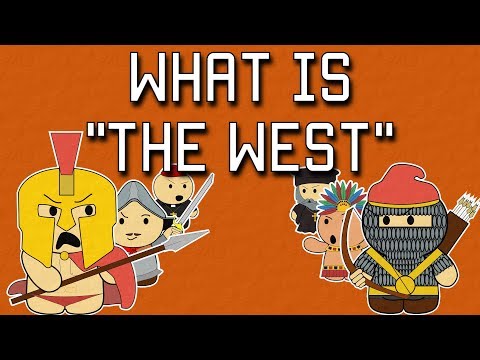
Except Sparta whose identity was based on death and sweet abs.
People such as Homer, Socrates, and Hippocrates are all titans in the fields of Western literature,
philosophy, and medicine.
They essentially kick started it.
Now don't get me wrong, an ancient Greek would be considered alien today if we met
one.
But the idea that Western Civilisation descends from the Greeks is as important an idea to
"The West" as an actual direct link.
Obviously modern Western Civilisation isn't the same as ancient Greek culture, later Westerners
chose what they wanted to adopt and what to abandon.
No one in the modern West is sacrificing goats to the gods or taking slaves just because
the Greeks did it.
The origins of the east-west division has roots in Ancient Greece, specifically in the
Persian Wars.
It is this conflict that we see the beginning of the liberty loving masculine West v despotic,
decadent, and feminine East trope.
A trope that we still see on-screen today.
One of the most important things Greece did for "the West" was influenced Rome.
Rome gave the future West the foundations for its governments, languages, and law.
The Roman law code was the basis for the legal systems of most of Europe and its colonies
up until the 18th and 19th centuries.
Rome provided the later West with an identity firstly through its Empire and then through
it's Church.
Christianity held "the West" together after Rome faded and would mold it's identity
up until the 19th century.
Christianity became the religion of Rome after the Emperor Constantine adopted it.
But just as importantly in the history of the West is something else Constantine did.
And that was establishing the city of Constantinople.
You see, the Roman empire had a cultural divide.
The West spoke Latin and the East spoke Greek.
So, the Romans began thinking with a Latins v Greeks mindset.
The Latins saw the Greeks as more effeminate and decadent compared to how manly and tough
they were, which added to the East v West idea.
Which is funny because the ancient Greeks thought the same in relation to themselves
to the Persians.
The Roman Empire eventually divided along these lines.
The Western half faded away during the 5th century and the Eastern or Byzantine half
lasted another 1000 years.
In 1054 the Western and Eastern Churches split from each other in an event known as the Great
Schism.
I won't go into detail because the Great Schism will be a video itself.
But the important take away is that after 1054 the Catholic Church separated from the
Eastern Orthodox Church.
A pope sat in Rome and a Patriarch sat in Constantinople.
The Eastern Roman Empire would eventually spread Orthodox Christianity into the Levant,
the Balkans, and importantly they converted the Rus.
This schism in combination with the Islamic conquests that began 3 centuries previously
gave the West's it's own identity.
They were West Christendom.
They may not have liked each other but they knew that they hated the Eastern heathens
and Muslims even more.
Constantinople would fall to the Ottomans in 1453 and afterwards the Greek, Roman, and
Islamic knowledge that they had accumulated and preserved was brought back to Europe by
scholars and traders.
The Renaissance with all it's fancy naked statues got into full swing.
The West began to re-import Western Civilisation, with all the additions the Byzantines, Muslims,
and others had made to it.
This rebirth of Western culture came along just before the discovery of the New World.
So the Europeans, now confident that their ideas and culture were superior began to colonise
the New World.
This is the beginning of the spread of "The West" and also the reason why the West is
such a hard term to quantify today.
By colonising and imposing their culture on other nations the West ended up in the Northern,
Southern, and Eastern parts of the world.
Which is confusing for a group the identifies as a position on the compass.
If you'd like to learn how the West managed to conquer so much then click that little
I in the top right corner to go to a great video by Grant Hurst.
During the Enlightenment the Western idea of the nation-state developed.
During this era European imperialism was brought to Africa and Asia.
As Westerners translated "Eastern" languages and interacted with the East more a kind of
"Orientalism" began depicting the East as an irrational, psychologically weak, and
feminized, Other, which was negatively contrasted the West's idea of itself as rational, psychologically
strong, and masculine.
The nation-state concept was imposed on places where it didn't make sense, resulting in
odd perfectly straight borders.
The enlightenment dulled the idea of West Christendom and birth the secular West.
This is when the West actually began calling itself the West and also using that term to
describe previous cultures, like the Greeks and Romans.
Skipping forward slightly.
After the 2nd world war the West lost its colonial power mostly.
The world entered the Cold War.
Which was an easy conflict to paint in the terms of East v West.
Communism v Capitalism.
The Western identity solidified during this period.
Who was Western and who wasn't, was clear.
But after the Cold War ended I think the term "The West" lost its solid meaning.
But it still continued to be used.
So what does "The West" mean today?
How do you define it?
Here are the usual Economic, Political, and Cultural definitions
Economically the West is usually developed countries with strong economies and high incomes.
Here it's used interchangeably with First world.
Politically it's countries with democratic governments and free citizens.
Here it's used interchangeably with Free world
Culturally it's countries with roots in Europe or the Greco-Roman-Judean tradition
and was built upon by the ideals of the Enlightenment.
Usually referred to as Western Civilisation.
But these definitions aren't great for actually defining the West.
For example let's look at Latin America.
Latin America much like the United States and Canada are inheritors of Western Civilisation
through their European colonisers.
Latin America however is rarely included when people speak about "The West".
They speak Latin languages and while there are some Latin American countries such as
Bolivia, Paraguay, and Guatemala that have a much stronger native influence they are
still heavily influenced by the culture of their colonisers.
If you look at a Human Development Index map you can see that many Latin American states
are in the high to very-high range, especially Argentina and Chile and Uruguay.
Their political institutions and governments are based on the same principles as European
ones.
Democratic governments are the norm in Latin America and most rank just below the US and
Europe on the Democracy index.
Latin America is definitely a part of Western Civilisation and should be included in "The
West".
You can try applying those 3 criteria to other nations too, like Japan, Turkey, and nations
that were previously behind the Iron Curtain.
And that brings me to my final point, criticisms of the term "The West".
An issue with the term "The West", other than its vagueness, Is that it implies confrontation.
West of where?
Different than where?
Edward Said claimed that "the West" was just a construct used by Europeans to justify
an opposition to the East, which could then justify colonialism.
"the West" usually defines itself by what it's not.
It wasn't the Persians.
It wasn't the Greeks or Orthodox.
It wasn't Islamic or Chinese or Indian.
It wasn't Russian or Communist.
And now it's not Islamic, again.
The notion of an Eastern other has played a central role in constructing a Western identity,
and helped to define the West as its contrasting image.
Which nowadays doesn't make sense because cultures and societies are mixing and learning
from each other on an unprecedented scale.
The West and the East need each other as our economies and societies would collapse without
the other.
"Western Civilisation" as a term is just an attempt to record the history of a cultural
unit in a easily understandable and linear fashion.
But "The West" as a term is simply used to refer to a blurry area of the map in people's
mind.
Which is why it is useful for the news or for politicians, it's just vague enough
to appear to mean something.
So when you hear someone refer to the decline of "The West" or how a group of people
hate the West.
Think, "what are they referring to?
What West?
Is all of Europe, the Americas, Australia, and New Zealand all in decline?
Have people stopped reading Plato?
Do these people that hate the West simply hate whoever they see as their enemy or do
they actually hate all of the places that might be in "the West".
Even Liechtenstein.
Can you really hate Liechtenstein?"
The purpose of this video isn't to demand that we begin using different terms for anything.
But it can be useful to know where certain terms came from and why they continue to be
used.
Kipling said that East is East and West is West and never the twain shall meet.
Except that they have and now both are different and better than before.
Thanks for watching.
This video was made in collaboration with Grant Hurst.
If you'd like to learn about how The West managed to colonise so much of the world then
check out his video.
The link is in the description.
I hope you enjoyed this video and if you'd like to see more click subscribe.
You can follow me on all me on Reddit, Twitter, and Facebook and don't forget to check out
my sources in the description if you'd like to learn more.
There are also links to Cogito merchandise if you'd like to support the show.

 For more infomation >> Social Emotional Learning What It Is and Why It Matters - Duration: 2:55.
  For more infomation >> TheBigFatNerd is here! Z tej strony TheBigFatNerd! - Duration: 0:27.

Không có nhận xét nào:
Đăng nhận xét