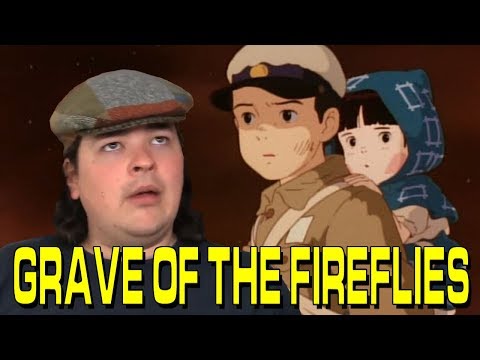
I was talking to someone recently and they told me about Bennett the Sage's
Grave of the Fireflies review. Now I had never seen Bennett's review of the film,
so I watched the video, and it was really shocking at how much misinformation
there was, and how Bennett just missed the point of the movie. Now it's an old
video. It's been up for a long time but since he's still hosting it on his
channel, and hasn't updated it, I presume it still reflects his opinion. So I feel
like it's my civil obligation to do a response and point out where Bennett
goes wrong. Now I would assume if you watch anime videos on YouTube you would
be aware of who Bennett is, but for those who don't know, he's this dude who makes
videos about anime and does it mostly in that passe nostalgia critic style. You
know, where it's not even really a review he just synopsizes the movie and then
cuts to like shitty comedy skits. Needless to say I'm not a fan. But I am a
fan of Grave of the Fireflies. I think Grave of the Fireflies is a
great film that confronts the audience, and forces them to consider things they
might not normally consider. Now this video will have a lot of spoilers, so you
really should watch grave of the fireflies before you watch my video. Even
if you don't watch my video, watch Grave of the Fireflies. It's a fucking great
movie. Who gives a shit about the stupid things I'm spewing? Anyway, for those who
are still with me, let's get ramblin. Grave the Fireflies was based off a 1967
novel by Akiyuki Nosaka, who wrote the book as amends for his guilty conscience.
To this day no English translation of the novel exists. This is Bennett's first
mistake and it sets the tone for the rest of the video. Grave of the Fireflies
wasn't based off of a novel. It was based off of a short story
Nosaka had written in 1967, for a magazine called Bungei Shunju. The story
is semi autobiographical. In the sense that Nosaka takes a real events of his
life, and puts them in a fictitious contex.t Obviously Nosaka's name is not
Seita, and he didn't have a sister named Setsuko. He did have a sister however,
that died of malnutrition during the war. Which was the impetus forGrave of the
Fireflies. Bennett also states Grave of the Fireflies has never been translated
into English. Which is completely untrue. The story was translated by James R.
Abrams in 1978, and published in a magazine called Japan
Quarterly that same year. I'll put a link to the PDF in the description of the
video. I recommend all fans of the film read the short story. It really gives you
more insight into the mindset of the characters and really paints a picture
of how difficult it was to live in Japan during the war. The depressing nature of
the film is not inseparable from its legacy. Hell, the very first scene of the
film is the ghost of Seta looking at himself dying on the streets, shortly
joined by the ghost of Setsuki. From the very first minute to the very las,t the
viewer knows that they're in for an inevitable sad end. Honestly, there isn't
much to the movie outside of it being a sad movie. When you break down the story
to brass tacks, you begin to realize how simple the plot is. There's a couple of
things Bennet says that are very telling. The first being, "the depressing nature of
the film is not inseparable from its legacy." From my understanding what he's
trying to say is, when talking about the legacy of the film.,when talking about
the film being an important animated film to 20th century, when talking about
the power of the film. We also have to talk about the fact that the film is
depressing. To which my response to him would be, so what, it's a depressing movie.
Where is it written that great movies have to be uplifting? Where does it say
great movies have to leave you feeling positive? On the contrary, what makes
Grave of the Fireflies powerful is that it's challenging and forces the viewer
to look at a very dark time in world history. And this approach isn't in unique to
Grave of the Fireflies. Million Dollar Baby, Sophie's Choice, and Requiem for a Dream
are all critically acclaimed films that have very dark subject matter. Bennett
then goes on to mention, the entire plot of the film can be summed up in a
paragraph. Now to be fair, Bennett is using this to later make a larger point that
the film is a sad movie with not much going on. Which is a gross misreading of
the film, but we'll discuss that in more detail later. But for the record, let me
say that detail is not indicative of good storytelling. Just because the plot
of the Grave of the Fireflies can be summed up in a paragraph doesn't mean
anything. It wouldn't be a better movie if you could sum the plot up in two
paragraphs. My Dinner with Andre is a great film
that can be summed up in one sentence. A guy has dinner with a dude named Andre.
And all the talk about trade disputes and blockades didn't make the Phantom Menace any
better. Let's not even mention the convoluted
nature of the Matrix sequels. Almost no one dialogue drives the plot forward.
What little plot there is to drive. So how does the film reach the
hour-and-a-half mark with a story that bare-bones? Lots of padding. Bennett seems
to be under this impression that all films have a sort of ABC plot, where
dialogue is the driving engine that moves the plot forward. like a Mission
Impossible movie. Like a movie where a guy needs to find a bomb, and every scene
he's getting a little bit closer, till he ultimately finds the bomb.
I guess Bennet isn't familiar with films that are meant to be character studies.
Like Glengarry Glen Ross, Clerks or the aforementioned My Dinner with Andre.
Movies that are about how characters relate to each other and how they deal
with these relationships. Now admittedly, Grave of the Fireflies doesn't have as
much dialogue as those films. The reason being Grave of the Fireflies
also uses imagery and music to convey its message. And the very scenes that
Bennett interprets as "padding" are actually scenes that are building
character development, and setting up the atmosphere for the world the characters
existent in. In the DVD features Ebert discusses the use of pillow shots. Well
you know in Japanese poetry, they'll use a pillow word. It will be a word or a
short phrase that essentially just represents almost a musical beat between
what went before and what comes after. And then if you look at the films of a
great director like Ozu. Who I think is one of the finest movie directors who
has ever lived. You will find what I call pillow shots.
He will be telling a story and the story will take place in a house. And it might
involve the father and his daughter, and some people have come to visit or the
neighbors next door or maybe a woman the father is about to marry or maybe a man
as the daughter is about to marry. And they'll talk and there will be some
interaction. And then a certain phrase will end and he'll cut outside and he'll
show something not necessarily a beautiful shot, it might be just a shot
of the corner of a building and then some railroad tracks in the back
or a window. And a roof line and some electrical wires or a tree and the
street. And he'll hold on that and then he'll come back inside. He's using it as
punctuation. It's a form of silence. It's a form of saying let's not rush headlong
from each scene to the next scene, but let's say okay this has happened now
we'll kind of look out the window and think about it. And now this has happened
and that will take another moment. And that use of the pillow shot gives his
films a kind of thoughtfulness and pacing that becomes really important to
you after a while. You begin to appreciate it. The movie moves slowly and
sparsely, because it wants you to contemplate what you're seeing. It's
trying to put you in the shoes of these characters. If you or someone living
during these times, you would do a lot of self-reflection. In an interview, Nosaka
talked about when he was a kid he would save her eating a tomato. Not
because it tasted good, but because the tomato was so full of
life, and that thought gave him comfort. Because in every waking hour he was
surrounded by death. Unlike with most films, the padding here
does serve a purpose, other than to stretch the runtime. But it's that same
purpose that I take issue with, and is really the crux of why I really do not
like this film. That purpose? Manipulation. These scenes were Setsuko plays in a
tub with her brother, or plays with a crab out on the beach, have little to do
with the plot. But they do portray what the audience perceives as actual
childlike behavior. In every sense Setsuko acts and talks like a real child
would, and Seita acts, for the most part at least, like how a responsible older
brother would. However, do not take this to mean that they have character, or that
they're really characters at all. Setsuko and Seita there are more constructs
than characters. What do I mean by that? Well it's hard to
articulate. But consider how the film treats them both. Setsuko and Seita are
thrust into the worst sort of situation imaginable, and it slowly erodes them
over the course of the film. Which is standard for any kind of sad story.
However, unlike other films where the audience sympathizes and connects with
the characters that they've come to know and perhaps identify with. The audience
sympathizes with Seita, and Setsuko especially, because the idea of their
situation is inherently sad. In the big picture it doesn't matter if it was Setsuko
and Seita suffering, or if there were two other children. So long as they
retain verisimilitude. We're not said that Seita and Setsuko are suffering.
We're sad because we're watching kids die, and that ties into what I was saying
about the film's manipulative purpose. Alright that was a long clip. But I
thought it was important to hear Bennett's critique without interruptions.
Something I found interesting is Bennett will say "the dialogue doesn't do much to
move the plot forward," or "the scenes of Seita and Setsuko playing have nothing
to do with the plot." But he never describes the plot. Which leads me to
believe, he doesn't know what the plot of the movie is. He doesn't know what the
movie is actually about. He watched the movie, and on a superficial level,
he knows it's about a brother and a sister during a war and that they died.
But he doesn't know what the movie is trying to say. He doesn't know the
meaning of the film. This idea that the protagonists are constructs and not
characters is laughable. It's also convenient Bennett tries to define what
a construct is, which isn't even a literary term. But he doesn't define
character. He doesn't explain how Seita and Setsuko fail as characters, he only
explains why they meet his made-up definition of construct. You could
definitely make the case that Setsuko isn't a fully defined character and
exists as an archetype of a four-year-old girl. But she's a
four-year-old girl, how deep of a characterization is she going to have. Every
four-year-old is basically an archetype of a four-year-old. Seita on the other
hand is a fully realized character. He has goals, he has flaws,
he has a sense of agency. Seita's motivation is to take care of his sister
and the well-being of the sister becomes the basis of every decision that he makes.
The reason he leaves his aunt's house, the reason steals food, is because he's
trying to do what's best for his sister. It's never ham-handedly telegraphed, where
Seita actually says, "the sacrifices I make, I make for my sister." His actions
speak for him. The relationship between Seita and Setsuko is the cornerstone of
the film, and you can even view the film as a tragic love story. Nosaka actually
describes it as a double-sided suicide story. Grave of the Fireflies takes place
during the fire bombings of Kobe, and is about two children trying to live a
normal life amongst all the chaos. The scenes Bennett so smugly describes as
"manipulation," are just accurate portrayals of life during that time.
Children played innocently, as bodies rotted, and houses burned. I'm sorry there
are no Gundams, or Pokemon, or epic martial arts battles. There are only two
children trying to find some sort of peace during war, and that's what makes
the film so compelling. That is the basis of the drama of the film.
Going back to what Ebert said about pillow scenes, as the kids play on the
beach you're supposed to be thinking about death. You're supposed to feel the
tension. Because during this blissful scene of two children playing, a war is
going on, and something awful is just around the corner.
Both Setsuko and Seita are thrust into the worst sort of situation imaginable,
and it slowly erodes them over the course of the film. Which is standard for
any kind of sad story. However, unlike other films where the audience
sympathizes and connects with the characters that they've come to know and
perhaps identify with. The audience sympathizes with Seita, and Setsuko
especiall, because the idea of their situation is inherently sad. In the big
picture it doesn't matter if it was Setsuko and Seita suffering, or if there
were two other children, so long as they retain verisimilitude. We're not sad
that Seita and Setsuko are suffering, we're sad because we're watching kids
die. This to me sounds like the logic of a contrarian, who's trying to explain to
you why a movie that's doing its job effectively, isn't doing a good job at
all. Here's why, Bennett is making the argument that the reason we feel sad for
Seita and Setsuko is not because they are developed characters, but because
they are realistic portrayals of children, and we would feel sorry for any
kid in that situation. Which is completely wrong,
and I can prove it. Let's say that Grave of the Fireflies wasn't about Seita and
Setsuko, let's say the movie was about their aunt, and for the whole movie
we follow the aunt. Then somewhere around the 20-minute mark
Seita and Setsuko show up. They play in the tub, they do their thing with the
stove, then they leave and we're back following the end again. Then around an
hour into the movie we cut to Setsuko dying. It will be sad but it wouldn't have
the same impact. It would be sad in an abstract sense. Because you know, from a
human perspective, it's sad or anyone dies but you wouldn't be moved to tears.
If Bennett's assertion is correct and it doesn't matter if the characters have
substance, because it's equally as sad when any kid dies, then you should be
crying the first three minutes into the movie when Seita dies. But you're not,
because you don't know who he is. The reason we feel compassion for Seita and
Setsuko is because we've gone on the journey with them, we've come to know
them as characters. The choices protagonists may are a result of their
personality, their choices are what define them as characters. The reasons
Seita and his sister are in a horrible situation is because of Seita's stubborn
personality. He made these bad choices, and put them in this situation. If you
took out Seita and Setsuko and plugged in two other children, who did the exact
same thing, of course you would feel sorry for them because they would have
had the same lived experience as Seita and Setsuko. They would have made the
same choices and goone on the same journey. If they were different children
with different personalities and made different choices, it would be a
different fucking movie with a different ending. It's like if you took a Rocky out
of Rocky, and replaced him with a guy named Gary, and Gary did everything Rocky
did. You would still cheer for Gary at the end because he would have had the
same lived experience as Rocky. If Gary was a different character with a
different personality and made different choices it will be a different fucking
movie. Considering the emaciated plot there's no real point to its story.
Neither character learns anything or takes anything away from over the course
of the film. Even when it sets up that possibility by having Seita swallow his
pride and return himself and a starving sister to the care of his mean-spirited
in passive-aggressive aunt. If it meant that Setsuko could have proper food and
shelter. Don't you have any other relatives? I don't know how to contact
them. Then take my advice and go back to that woman son. Everything is rationed
now, you can't survive outside the system. Just swallow your pride and apologize.
Thanks anyway, I'll just go and ask someone else. However the film never
follows up on this. As if Seita never had a moment's doubt that staying away
from his aunt was the right choice. What could have been a defining moment of
Seita's character, instead treated as just another unfortunate habit stance
along the way to an inevitable and unavoidable end. It's at this moment it
becomes facepalmingly clear Bennett has missed the point of the movie. Bennett is
hung up with this idea of character arc, and Seitta doesn't change through the course of
the story. This is the thing, Seita is a tragic character with a tragic flaw. As I
mentioned earlier Seita's main goal is to keep his sister safe, to protect her from
the horrors of war. This sentiment is embodied by the fact that Seita doesn't
want Setsuko to know their mother is dead. He tries to keep this from her for
the entire film. But when Seita sees Setsuko burying the
fireflies, and she says she's burying the fireflies just like their mother was
buried, Seita breaks down and cries. He cries for the first time in the film.
Because at this moment Seita knows he can't protect his sister. He couldn't
protect her from knowing their mother was dead, and he can't protect her from
the outside world. He has failed at his goal. So when the old man tells Seita to go
back to his aunt, he doesn't, even though he knows he can't
protect his sister. this is Seita's defining moment as a character, when
given the chance to fix things, Seita continues to make the same bad choices.
He is doomed to repeat himself. It's what leads to his sister's death,
and it's what leads to his downfall. Now the reason Bennett missed all this, is
because he decided the movie doesn't have characters in it. You could say that most
every sad film is guilty of manipulation in this way, but the best
sad films don't make you aware they're manipulating you.
Fireflies on the other hand couldn't be more obvious it it tried, and nowhere is
it more apparent than after Setsuko dies. The film goes into a montage of Setsuko
doing little girl things for no reason other than to make the audience sad.
All to the tune of a wistful operatic Aria. This idea that a good sad movie is
a movie you don't know is manipulative, and a
bad sad movie is one that you do know is manipulative, is a rule Bennett made up. I
don't have hard and fast rules about movies, I take every film on a
case-by-case basis. That's why I don't listen to these motherfuckers, who want
to tell you that practical effects are always better.
You shouldn't create blanket rules for yourself, it's only going to limit your
thinking. But this idea that the montage of Setsoko doesn't have a purpose and
is just there to tug at your heartstrings is false.
What's worse, this montage is from the audience's point of view.
This isn't Seita remembering her, because he's not anywhere to be found. So how
could he be remembering something that he wasn't there for? You know I've heard
people say American audiences are stupid, and that clip of Bennett is a perfect
example why. These are Seita's memories. The scene that precedes the montage is
Seita getting ready to carry Setsuko's body to the funeral pyre, and the scene
that follows the montage is seda burning Setsuko's body. As the montage is playing
Seita is carrying his sister's body up the hill, and memories of her are
flashing through his head. If you are carrying your sister's dead body, these
are the things that would be going through your mind. Now the movie isn't so
ham-fisted as to have Seita standing there going "I remember my sister," cue the
fucking montage. To the movies credit it assumes you're smart enough to put these
two things together. The breaking point however is when Setsuko uses a bowl as a
helmet and snaps a salute to no one. This is contrivance at its purest.
She's a casualty of war. You see when we think of war, we think of soldiers going
off and dying. We forget that there are innocent people who die too. Setsuko
puts on the bowl helmet and salutes, because it's meant to symbolize just
like a soldie, she is also a casualty of war. This is
what cinema does it uses imagery to convey an idea. This is why Grave of the
Fireflies is great it's not spelling it out for you. The movie... I can't
believe...
What does this all mean? It means Takahata intended to wrangle
this troublemaking generation into parental compliance through guilt. True,
he didn't word it quite like that. But when fireflies juxtaposes a scene of
affluent happy-go-lucky young people who are relieved to find all their stuff had
survived a bombing, with that previously mentioned montage a Setsuko, it becomes
quite clear what Takahata meant and why the film specifically targets the
younger generation. The real defining moment however, comes at the very end as
the ghosts of Setsuko and Seita sit on a park bench overlooking modern Kobe.
Already the message is clear enough but right before they cut to the cityscape
shot, Seita breaks the fourth wall and gives the audience a grave accusatory
look. As if to say, this is what happened to your parents you ingrates.
Alright so Bennett isn't completely wrong. If you read the Takahata and Nosaka
interview in Animage magazine, and watch the interview with Takahata on the DVD. He
actually states he intended the film to be a sort of parable of pride and
rebellion. Takahata intended Seita to be a sort of modern teenager living during
the war. Takahata felt Seita had a lot of traits that were common in modern
kids at the time. He was rebellious, he wasn't appreciative his aunt,
he thought he could solve his problems with money. These are the things that led
to his downfall. Seita I didn't learn to accept help from others, he didn't learn
money wasn't that important. That's why the movie could be looked at as being
sort of a parable. There's nothing wrong with the movie trying to impart a lesson
to the audience. Every slasher film you see is about premarital sex. Scarface is
all about how one man's ego can lead to his downfall.
Having a clear morality isn't unique to Grave of the Fireflies.
I also find it strange Bennett takes issue with the image of Satan in Setsuko
overlooking modern-day Kobe. The idea of cultural literacy and the ghosts of
the past is an idea that is ever-present in the movie. Sprinkled ever-so-slightly
throughout the film, is the ghost of Seita watching himself and reacting to the
choices he makes. Reinforcing the idea that those difficult times are things we
should never forget. What makes Grave of the Fireflies different from other sad
movies like Dumbo, is that the firebombing of Kobe actually happened.
Innocent citizens have to live through it. It may be difficult for you to watch, but
how do you think it felt actually live there? Forgive me, but I can't help but
think the movie earned its right to be a little preachy.
Am I the only one who finds this kind of awful. I mean even if Takahata only
intended for the best and truly wanted to inform the younger generation of the
hardships during the aftermath of World War II, co-opting someone else's personal
tragedy, and fabricating events to suit this intended goal is straight-up
duplicitous. What the fuck are you talking about? Takahata
didn't co-opt or fabricate anything? As I stated Grave of the Fireflies was
adapted from a novel, a semi autobiographical novel. Nosaka based
the book on his own experience growing up during wartime and how he felt
responsible for letting his sister die of starvation.
He talked about purging demons from his past that had haunted him for decades,
dedicating the book to her when it was published in 1967. His story is
understandably tragic and it's a good starting point for a film with this kind
of goal in mind. But why did the film have him die?
Because Seita died in the original fucking story you dipshit! Do you not
know the difference between autobiographical and semi
autobiographical? Seita died in the original short story.
You did not read the original story. You didn't even know the story was published
into English. You have no idea what you're talking about. Well if Seita
had survived, just like Nosaka then we would have stops being a construct
and started being a defined character. He would have had to deal with survivor's
guilt and be damning his pride that kept him from going back to live with his
aunt. The only moment by the way that Seita exhibits a characteristic that
doesn't revolve around being an older brother. However, this also would have
made the story too insular and personal, making it harder for the intended
generation to project their own parents into the film. It would be Seita's story
not their parents. So Seita dies and whatever guilt he may have felt and
would have struggled with, dies with him. I know that adapted films often change
details from its source material. But they're usually changed for
accessibility reasons, or for reasons regarding their
the differences between mediums. But when they're changed because they wouldn't of
fit the directors intended vision, that's usually when the adaptation goes
off the rails. Grave of the Fireflies is an almost scene for seeing adaptation of
Nosaka's original story. Please, allow me to read you some passages from the Grave of
the Fireflies short story.The seriously wounded have been interned in
the industrial arts room at the end of the first floor. Those even worse off, on
the verge of death, had been laid in the teachers room inside. The upper half of
his mother's body was covered with tape. Her arms looked like wrapped up baseball
bats. Her face too wound round and round with rolls of tape. Only at her eyes, nose
and mouth black holes opened up. The end of her
nose exactly like a coating of tempura. Co-opting someone else's personal
tragedy and fabricating events to suit this intended goal is straight-up
duplicitous. Seita sprang onto the horizontal bar with the great swing.
Pulling his body up onto it and began spinning around without end. Co-opting
someone else's personal tragedy and fabricating events to suit this
intended goal is straight-up duplicitous. With her hair arranged the hollows of her
eye sockets became that much more prominent. What was passing through
Setsuko his mind? She picked up two stones within hands reach. "Seita please
help yourself, huh. Dinner. Would you like some tea? And then I've cooked some
bean curd. I'll serve you some." Like playing house she lined up lumps of
Earth and stones. "Please go ahead. Won't you have some dinner?"
Co-opting someone else's personal tragedy and fabricating events to suit
this intended goal is straight-up duplicitous. He leaned stoop-shouldered
against a bare concrete pillar. Its mosaic tile now peeled off. Inside the
Sannomiya station of the public intercity line shore side exit. Sitting
on the floor both legs stretched out he was burnt to a crisp by the Sun, had not
washed himself for nearly a mont, but the color of status emancipated sheikhs
was yet pale. Sunken. The hunger was already gone, there
was no more thirst. His chin lay heavily on his chest. "Oh my he's so dirty." "Looks
dead to me." "Shameful isn't it? With the American army
arriving any minute, such a sight in the station." His ears
alone remained alive, distinguishing the various sounds around him. "Today. What day?
What day is it? How long have I been here?" His sense reviving, he became aware of
his body in the very V shape of his sitting posture. Sinking sideways to the
floor looking, fixedly at the faint dust of the floor, quivering in response to
his weak breath. While thinking only what day is it, what day is it,
Seita died. I know that adapted films often change details from its source
material. But they're usually changed for accessibility reasons or for reasons
regarding their respective differences between mediums. But when they're changed
because they wouldn't have fit the directors intended vision, that's usually
when the adaptation goes off the rails. You're an idiot!
So from our perspective we can see the film as an anti-war film, that really
depicts what war reduces humanity to. But even that has been taken away from us by
Takahata. Unlike with this previous statement about wanting to invoke
sympathy with teenagers, Takahata was extremely clear about how Grave of the
Fireflies was never meant to be an anti-war film. "The film is not at all an
anti-war anime and contains absolutely no such message." There is no wiggle room
in that statement and no other way to interpret that but literally. Okay, so
this is why I wanted to make this video and I'm going to try my best to nip this
in the bud once and for all. This quote Bennett flashes on the screen,
that he had attributes to Takada and sources from Animage magazine, doesn't
come from Animage magazine. Tt comes from Wikipedia. If you go to Wikipedia you
could see the quote right there. Now at the end of the paragraph is annotations
that give us two sources. One of those sources is the Animage article Bennett
sites. But as I said before, that quote is nowhere to be found in the article. I
guess Bennett knew he would look stupid if he cited Wikipedia. So he just assumed
the Animage article contained the quote, but he never bothered to check.
The other source is a Japanese book that the translated English title is
"Things I Thought While Making Movies." I can't find an English translation of
this book anywhere on the internet. So I have no way of verifying if this quote
is in that book either. I can't say for certain where this quote even comes from.
In fact every article that makes the argument Grave of the Fireflies is not
an anti-war film cites this quote from Wikipedia. Nobody has bothered to try to
find out where the quote comes from. They just assume Takahata must have said it.
But let's say for the sake of argument Takahata did in fact say this We don't
know what he said before, it and we don't know what he said after it. We have no
idea what the context of his quote is, all we have is a quote dangling in the
ether. Interestingly enough if you do a little research you come to find that
Takahata is actually a very open anti-war activist. He's a founding member
of Eigajin kyu-jo kai, which is a group of filmmakers who are outspoken about
preserving article 9, and stress the importance of keeping Japan a pacifist
nation. When giving a lecture in Tokyo about the possibility of Japan becoming
a war nation Takata said, "Japan has made several animated films depicting the
horrors of war, a feat that is rare even throughout the world. Though that is
quite meaningful, that simply isn't enough to stop it from happening."
Even though Takata doesn't directly mention Grave of the Fireflies,
unless Takahata is completely dense, I think he would agree Grave of the
Fireflies depicts the horrors of war. He also says something that gives us a
little more insight into his mind. "Though that is quite meaningful, that simply
isn't enough to stop it from happening." In an article with Kanagawa Shimbun,
Takahat expands upon this thought, and directly references Grave of the
Fireflies saying this, "Grave of the fireflies is considered an anti-war film,
but while anti-war films are meant to prevent Wars and stop them, that movie
doesn't fill that kind of role, even though that might surprise most people.
No matter how often you talk about the experience of being in a horrible
position of being attacked, it would be hard for that to stop war." What this
sounds like to me, is that in Takahata's mind an anti-war movie is a movie that
was made with the expressed goal to stop Wars, and has the ability to stop wars.
Going back to the Animage article, Nosaka says "I hate so-called anti-war movies
and I also hate movies where the main character is placed into cruel
situations for no other reason than to provide a cathartic
focus for the audience's sympathy. Nosaka says this in reference to the making of
the film. In his opinion these are the cliches
Grave of the Fireflies avoids, because Grave the Fireflies is not directly
about war. Tt's about the relationship of a brother and sister during the war. But
this sounds like an issue of semantics. Whether the movie was made with the
intentions of stopping Wars, or if the movie is about a relationship and just
happens to show the horrors of war, either way you slice it you come away
thinking war is bad. Grave of the Fireflies most certainly isn't a pro war
film, and the scenes of people running away screaming from airplanes bombing
their houses hardly make it seem like the movie is agnostic on the subject.
There's a quote from Steven Spielberg that says "Every war movie good or bad, is
an anti-war movie." The reason Spielberg said this is
because in his opinion, any film that realistically shows the brutality of war
is inherently making an argument against war.
So using Spielberg's definition Grave of the Fireflies is an anti-war film. On the
flipside if we were to take Takahata's definition, Saving Private Ryan would be
an anti-war movie if Spielberg made it with the expressed purpose of stopping
Wars, and the movie had the power to do so. It's also worth mentioning Francois
Truffaut. Truffaut's stance on anti-war films was the opposite of Spielberg's.
Truffaut felt that movies that claim to be anti-war are actually glorifying war,
because the thus is the nature of cinema. Situations that may seem dire in real
life don't look so bad in the context of the movie and can sometimes be
attractive. So as I said earlier this issue about whether or not Grave of the
Fireflies is an anti-war film is a matter of semantics. Actually a better
way to put it, is it's a matter of interpretation .It's like arguing about
whether 28 Days later is a zombie movie or not, it just depends on how strict
your definition of the word is. Depending on your definition of vampire, Near Dark
may or may not be a vampire movie. It just depends on the way you want to look
at it. But it shouldn't be surprising to anyone, that Takahata a man who is an
outspoken anti-war activist, made a film that has a very strong anti-war
sentiment. Whether he intended it to or not. While
Takahata has no control over how people see this film, he does have control over
its intent. If people want to see an anti war message in the film that's the
right - but it's incidental, and to insist that there is an anti war message
would infer ignorance. No Bennett, you are the ignorant one, and I will tell you why.
You took a story that you didn't read, you just made assumptions about the plot.
You didn't even bother to find out it was printed in English.
You took a quote, that you don't know where it comes from and you don't know
what context it was said in, and you used it as the basis to psychoanalyze the
intentions of the filmmaker. You watched the film and ignored the fact that
children are starving because of the war. You ignored the people running away
screaming from military planes. You ignored people dying from having their
houses bombed, and you decided there isn't an anti-war message in the film,
because you read a quote from Wikipedia. That my friend is piss-poor film
criticism. Now to Bennett's credit he does admit he's reading a lot into Takahata's
motives, but that doesn't excuse anything, because his speculation is the basis of
his argument that Takahata's is changing the source material to try to manipulate
the audience. Which is false. The reason why Tarantino never explains to people
what's in the briefcase in Pulp Fiction, is because he wants people to interpret
the film on its own merits. He doesn't want idiots going, actually Tarantino
says the briefcase only has diamonds in it. Now you can think whatever you want,
you can think Marcellus' Soul in the briefcase.
But it's ignorant if you ignore it Tarantino said, because he's the guy that
made the movie. Everything you need to know to understand Grave of the
Fireflies is in the make up of the film. To find the meaning of the film all you
need to do is watch it. Bennett could try to spin his comments or qualify them any
way he wants, but he flashes this quote on the screen in an attempt to stifle
people's thinking. It doesn't matter what Takahata said, it doesn't matter what
Spielberg said, it doesn't matter what anyone says. What was Van Gogh's reason
for painting Starry Night? Nobody fucking knows! Artistic intentions and the
thoughts of the artist are important, and should be considered, but ultimately the
work will speak for itself. The way you understand films is by watching them, and
engaging with the ideas the film is actually presenting. You do
that by having an open mind and allowing the film to challenge you. You don't do
that by being an uninformed contrarian, who ignores the ideas the film is trying
to convey, and then looks for quotes on Wikipedia to justify their assumptions.



Không có nhận xét nào:
Đăng nhận xét