JUDY WOODRUFF: But first: Since Russia's invasion of Ukraine and annexation of Crimea, both
Russia and the U.S. have moved their forces, and held military exercises on a scale not
seen since the Cold War.
American and NATO troops are now positioned in Eastern Europe and the Baltic states, close
to Russian forces.
They are constantly drilling and practicing for what, if it happens, would be a real war.
Special correspondent Ryan Chilcote was recently in Poland to watch these exercises.
RYAN CHILCOTE: It's a military exercise of extraordinary complexity, 800 soldiers, attack
helicopters, tank busters preparing to fight an army with weapons and a level of sophistication
the U.S. military hasn't seen on the battlefield in decades.
Mistakes are bound to happen.
MAN: You fully acknowledge you're (EXPLETIVE DELETED) dead right?
You have got to rethink how you are going to do this.
MAN: Yes, Sergeant Major.
RYAN CHILCOTE: Colonel Patrick Ellis commands the soldiers training today.
So, how is this exercise going so far?
COL.
PATRICK ELLIS, U.S. Army: It's good.
I mean, look, it's a training event.
So, they didn't show up out here expecting that it was all going to be perfect right?
RYAN CHILCOTE: These infantrymen are less than an hour's drive away from Russian troops.
NATO stationed them here after Russia intervened in Ukraine.
The scenario, the Russian army has just seized a strip of land in one of the Baltic countries,
just like it did in Ukraine.
The difference this time is, it's a NATO country and the U.S. Army intends to take it back.
COL.
PATRICK ELLIS: This is the highest end scenario that we could possibly think of the train
on.
It's a great opportunity for us to practice the worst-case scenario.
RYAN CHILCOTE: The drill's main feature is a trench that's nine football fields' long.
The U.S. military modeled it after a trench used by pro-Russian fighters in Eastern Ukraine.
COL.
PATRICK ELLIS: What we're preparing for here is this kind of a toe-to-toe fight here in
the trench, using these tools in order to make sure that that fight as unfair as humanly
possible.
RYAN CHILCOTE: Kevin Muhlenbeck is the 2nd Cavalry Regiment's sergeant major.
How real-world is this if there was a conflict with Russia?
SGT.
MAJ.
KEVIN MUHLENBECK, U.S. Army: Sir, I will tell you, I have been doing this for 25 years,
and this is some of the most realistic live-fire training that I have ever done.
It's amazing how fast it would go right back to trench warfare, World War I.
RYAN CHILCOTE: Colonel Christopher L'Heureux is the commander of the NATO unit.
COL.
CHRISTOPHER L'HEUREUX, U.S. Army: I forget who said it, but they say that history never
repeats itself, but sometimes it rhymes.
This skill set is a tough thing to master, and which is why we get our guys to come in
and go after it again and again and again.
RYAN CHILCOTE: If Russia and NATO end up in a conflict in the Baltics, who wins?
DAVID SHLAPAK, RAND Corporation: Russia would defeat NATO.
RYAN CHILCOTE: David Shlapak is with the RAND Corporation, a think tank that advises the
U.S. military.
After Russia annexed Crimea in 2014, Shlapak set up a war game to consider what might happen
if Russia made a sudden incursion into the Baltic countries of Estonia, Latvia and Lithuania,
all of which are now NATO members and former Soviet Republicans.
DAVID SHLAPAK: Our analysis is that NATO's forces would be outgunned, outnumbered, and
overwhelmed in 36 to 60 hours.
RYAN CHILCOTE: Since that initial analysis, NATO has deployed about 4,000 troops to Poland
and the Baltics.
But RAND's view hasn't changed.
DAVID SHLAPAK: The work that NATO has done since then are important symbolic measures
that indicate the alliance's commitment, but in terms of actual combat power, they're minimal
contributions and make very little difference.
RYAN CHILCOTE: I think a lot of Americans would be surprised that if Russia and NATO
got into a conflict, it would be a land war.
A lot of people assume we'd be looking at nuclear war.
DAVID SHLAPAK: Escalation to the use of nuclear weapons is one very plausible outcome of any
war between Russia and NATO.
It's one reason why our work focuses on preventing a war from happening in the first place.
GEN.
BEN HODGES, Commander, U.S. Army Europe: Russia talks all the time about use of nuclear weapons.
RYAN CHILCOTE: General Ben Hodges is the commander of U.S. ARMY Europe and believes RAND has
it wrong.
LT.
GEN.
BEN HODGES, Commander, U.S. Army Europe: I completely disagree with their assessment.
And we talked about it.
If everybody was asleep, if Baltic countries had done nothing to be prepared, and we were
completely surprised, it would really, really be bad.
But over the last two years, what I have seen from our Lithuanian, Latvian and Estonian
allies in terms of fulfilling their responsibility, they're living up to it.
And then you add in these formations with 1,000 troops, tanks, a real capability, it's
a completely different set of circumstances than I think what the RAND study anticipated.
RYAN CHILCOTE: At the end of the Cold War, there were 16 NATO member nations.
Today, there are 29.
Vladimir Putin says, with the collapse of the Soviet Union and its aggressive foreign
policy, NATO should have been dissolved, not encroaching on its borders.
VLADIMIR PUTIN, Russian President (through translator): Our biggest mistake was that
we trusted you too much.
You interpreted our trust as weakness, and you exploited that.
RYAN CHILCOTE: For General Hodges, the mistrust goes both ways.
GEN.
BEN HODGES: I don't think that's likely, that Russia would out and out attack.
Of course, I was wrong -- I never anticipated they would attack Crimea or the Donbass in
the Eastern Ukraine.
So I'm reluctant to say, well, they would never attack Lithuania, they would never attack
Latvia.
RYAN CHILCOTE: Using a term not heard much since the Cold War, NATO says it wants to
deter Russia from even contemplating an invasion.
The goal, make that prospect look painful, with significantly fewer NATO troops.
GEN.
BEN HODGES: I was a lieutenant here in 1981 in Germany, about 300,000 soldiers in West
Germany when there was East and West Germany.
Today, we have 30,000 soldiers.
Our task is to make that 30,000 look and feel like 300,000.
RYAN CHILCOTE: The NATO exercises are just the most recent in the tit for tat of exercises
on both sides of this showdown.
In September, Russia conducted what may have been its largest military exercise since the
collapse of the Soviet Union, fielding tens of thousands of troops.
What was your takeaway from those Russian exercises?
COL.
CHRISTOPHER L'HEUREUX: Frankly, it's that they're not as good as they say they are.
I mean, who hasn't seen the picture of the accidental rocket launch at the VIP stands?
Obviously, the guy was flipping knobs, flipped the wrong knob, hit the wrong button.
RYAN CHILCOTE: Russia appears to be hitting several buttons, as the colonel learned after
a day in the field, returning to his phone that had been hacked.
COL.
CHRISTOPHER L'HEUREUX: And I turned it on, and it had lost iPhone on it.
And I'm like, huh?
What the heck?
So I thumbed through it.
And it says, somebody is trying to access your iPhone Apple account, and it shows you
a picture of a map, and the city in the middle of the map was Moscow.
RYAN CHILCOTE: NATO insists that it doesn't have Moscow in its sights and remains a defensive
alliance.
COL.
CHRISTOPHER L'HEUREUX: NATO wants to say, hey, we're not being offensive, right?
We're not trying to expand or do anything.
We have just enough force to give you a pause.
Without us here, it's still a problem for Putin, but, with us here, we make the math
problem a whole lot harder if Russia decides they want to take something.
RYAN CHILCOTE: After NATO's exercises in October, the Russian government said it is considering
adding troops and missiles near the border.
For the "PBS NewsHour," I'm Ryan Chilcote in Orzysz, Poland.


 For more infomation >> "빌보드 10위 향해" for 방탄소년단, 컬래버 추천 ★ 다섯 - Hot News 24/7 - Duration: 11:03.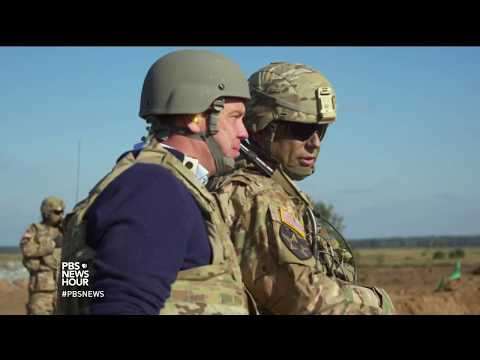
 For more infomation >> Tools for Schools: North Crowley Elementary - Duration: 1:05.


 For more infomation >> Danville police looking for suspicious Jeep - Duration: 0:46.
  For more infomation >> Texas still waiting for additional funds to extend CHIP through February - Duration: 2:10.
  For more infomation >> Union Station renovation project receives award for brownfield redevelopment - Duration: 0:52.
  For more infomation >> Catering for Defence Studies opened in Visakhapatnam - Duration: 1:35.

Không có nhận xét nào:
Đăng nhận xét