But the Normandy format meeting
took place on the sidelines of the Munich conference.
And what is the conference itself doing ten years later?
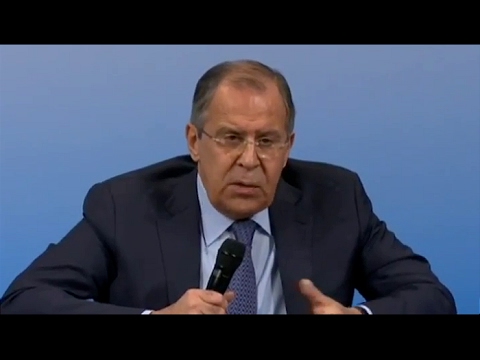
The most important Russian representative,
Foreign Minister Sergey Lavrov,
not only gave a speech, but also went through a marathon of diplomatic talks.
But what makes this conference really special
is that its participants from the West have a bigger bone to pick with each other
than with Russia.
Reporting from Munich is our staff European journalist
Darya Grigorova.
The climate is nice.
We can only guess what climate
the Russian Foreign Minister is talking about
shortly before giving his speech.
The climate in the hotel where the conference is taking place is cloudy.
The conference agenda can be described with one word, "uncertainty."
An entire period of history which can be called
the post cold war order
has come to its end.
Before having a closer look at the Minister's speech,
which became one of the key events of the conference,
we need to rewind.
This is a bilateral meeting with the NATO General Secretary, Jens Stoltenberg.
We strongly believe that dialogue with Russia is crucial.
I know, I know.
From the position of force.
From a predictable position.
We can make use of predictability.
The Russian conference room resembles a conveyor belt:
there's not even enough time to change the flags
before the arrival of the next delegation.
Apart from Stoltenberg, this room has seen Foreign Ministers
from France, Iran, Turkey, South Korea,
Slovakia and Israel.
But the content of his conversation with the NATO General Secretary
was disclosed by Lavrov only today.
At some point, the President of Finland, Mr Niinistö,
though he's not a member of NATO,
expressed his concerns about the fact
that airplanes belonging both to Russia
and Alliance countries
are flying over the Baltic region with their transponders turned off.
During his visit to Russia
he mentioned this to President Putin,
after which Putin charged the Russian military
with drafting a proposal
on how to resolve not only the transponder issue
but the question of aviation security in the Baltic region in general.
A detailed proposal was presented by our military
in Brussels,
last July I believe,
at a NATO-Russia council meeting.
We were sure that these specific proposals
would get an immediate reaction,
and experts would start working on the measures
aimed at increasing aviation security.
That didn't happen,
and to this day this work hasn't been started.
Yesterday Jens Stoltenberg told me
that there are hopes that the experts will meet in March.
The conference room where Sergey Lavrov gave his speech
couldn't fit all the delegates who wanted to listen to the Russian Foreign Minister.
So dozens of conference participants
have gathered around TV screens to see the broadcast.
Former German Minister of Defense, Franz Josef Jung,
who made it into the conference room
asked a question about Minsk Protocol.
An hour earlier, at this very spot, Federica Mogherini, the EU Foreign Minister,
reiterated that the sanctions would be dropped
only after Russia follows through with the Minsk agreements.
Lavrov responded unexpectedly.
We won't drop our own sanctions against the EU
until the Minsk agreements are fulfilled.
You should keep that in mind too.
I know that the real situation taking place in Ukraine
and the real reasons
why the Minsk agreements are stuck,
are well known in Paris, Berlin
and, I dare hope, in Washington,
as well as in the other capitals,
including the NATO Headquarters.
It's obvious that most of the audience
would prefer to see Russia held responsible for the Minsk Protocol.
Russia has to comply with the Minsk agreements
and reduce the violence in the Eastern Ukraine.
The Munich conference members
are greeted on the streets by anti-globalists.
The rally has basically become a tradition, the same can be said about anti-NATO slogans.
But hardly ever before has the rally actually touched a nerve
with the conference participants
who have yet to decide the future of NATO,
which some are calling "outdated".
Reassuring partners worried about contradictory statements –
that's the goal of the big American delegation in Munich.
So the rhetoric is quite familiar.
Pence strikes me as a politician
who hasn't yet decided on his political stance.
He was obviously reading from notes
prepared by his assistants or maybe his bosses.
He didn't offer us a chance to ask questions
as is customary at the Munich conference.
By the way, yesterday James Mattis, the Head of the Pentagon,
also avoided all questions.
It means that the Americans are still working on their stance.
Although in his speech the American Vice President confirmed
that Donald Trump is looking for common ground with Moscow,
Pence himself appeared unready to have a dialogue with Russian journalists.
What is your view on US relations with Russia?
Sorting through the Transatlantic relationships is at the forefront of this year's meeting,
which was meant to be a NATO insider meeting from the start.
But Petr Poroshenko managed to get extra attention
directed to the cost of the deteriorating situation in Eastern Ukraine.
Putin hates Ukraine deeply and with all his heart.
He disregards the identity of Ukrainian people.
I know that.
Even his colleagues from Eastern Europe,
members of the North Atlantic Alliance,
would, before saying anything else, remark that Poroshenko is driven by emotion.
We have to understand the Ukrainian President's emotions.
Of course,
the situation in the Eastern Ukraine is very difficult.
So, I think we should do our best to resolve this issue
and resume a rational dialogue
about solving other problems.
The President and the Foreign Minister of Ukraine
were accompanied to Munich, inexplicably, by Vitali Klitschko, the Mayor of Kiev.
Moreover, he shared his own views
on the future of the North Atlantic Alliance.
Talking about our mutual security,
we should take note of current geopolitical changes,
as well as actions
that are reshaping territories
that first appeared as the result
of military actions in Europe during World War II.
All this suggests that the entire framework of NATO should be revised.
Clearly, the Mayor of Kiev was inspired
by the speech given by Germany's Chancellor, Angela Merkel.
Only he missed one thing:
Apart from everything else,
the Chancellor didn't just express willingness to work on NATO's relationship with Russia.
She talked about particular steps
of bringing cyber-security issues to the Russia–NATO council for review.
I'm drawing on a premise
that Berlin at the very least wants the Russia–NATO council
to resume its full-fledged operation,
instead of limiting itself to talks and nothing else.
However, when many say "cyber-security",
they have in mind Russia's tampering with the US election.
Sergey Lavrov asked his colleagues to present evidence
and reexamine their relations.
The German story was shown to be a fact.
You know when it happened, several years ago.
It was confirmed that top officials had had their phones tapped.
The other day there was a leak showing
that the 2012 Presidential election campaign in France
coincided with cyber-espionage on the part of the CIA.
And talking to a journalist today, a CIA representative said
that he has no comments to offer.
I repeat. Show us the facts.
Once again, Russia had a lot to say in Munich.
And the West had a lot of questions and heard many answers.
But the key question at the moment is,
do the Western parties hear each other?
Darya Grigorova, Anton Chegaev, Alexander Korostelyov.
Vesti on Saturday from Munich.



Không có nhận xét nào:
Đăng nhận xét